


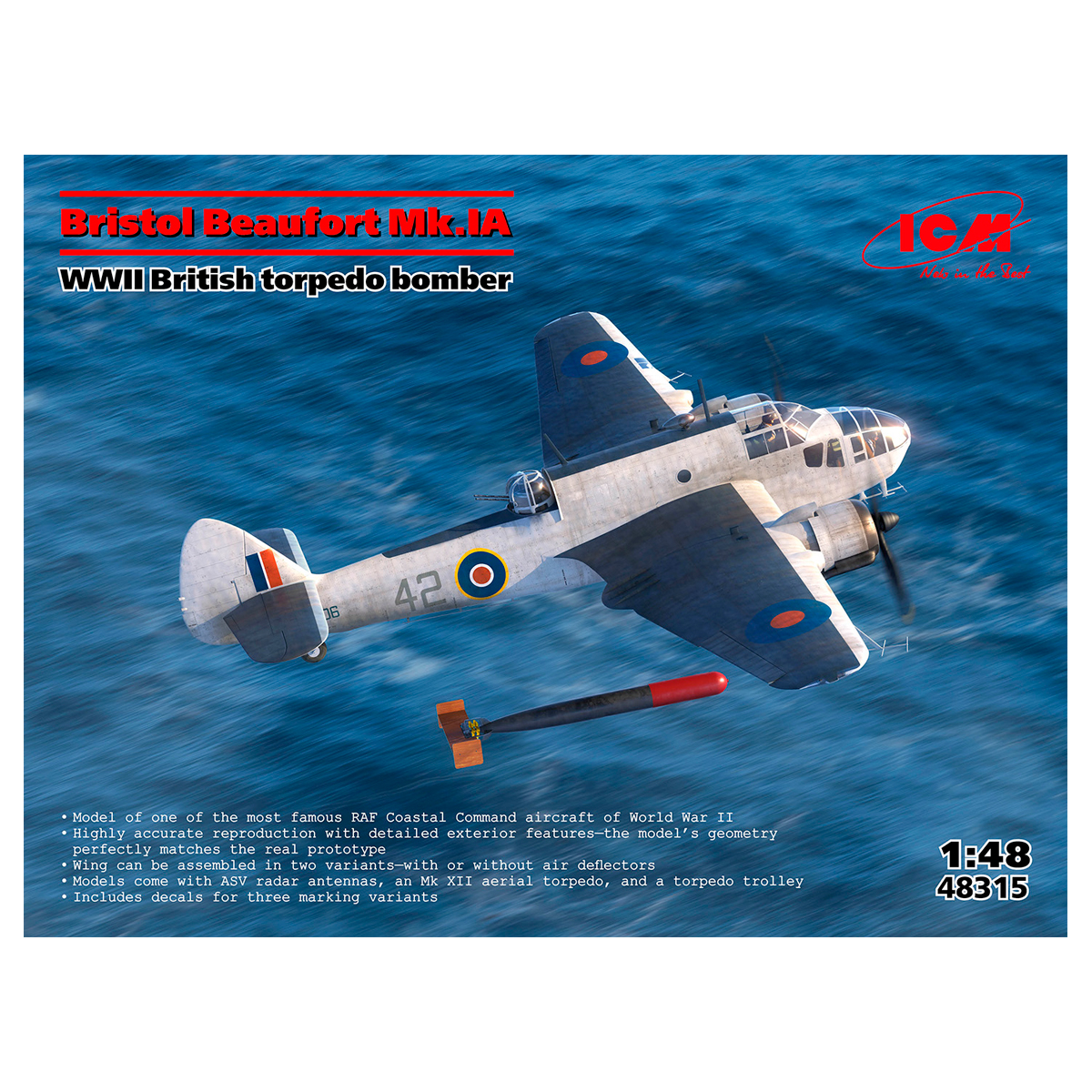


1/48 Bristol Beaufort Mk.IA, WWII British torpedo bomber
60,95€
Only 1 left in stock

*Please check our Privacy Policies to see how to we use your personal data.
*Por favor revisa nuestra Política de Privacidad para ver como tratamos tus datos personales
ICM 1/48 Bristol Beaufort Mk.IA, WWII British torpedo bomber
The Bristol Beaufort torpedo bomber was developed by the Bristol Aeroplane Company. It was a four-seat, twin-engine aircraft with a mid-wing configuration and an all-metal structure. Its defensive armament included a rearward-facing machine gun turret for protection of the rear hemisphere, as well as machine guns mounted in the fuselage sidewalls for firing to the sides. In the nose, one or two Vickers machine guns on a movable mount could be installed for front hemisphere defense, and some aircraft also had a lower machine gun position for rearward fire.
From the end of 1939, the Bristol Beaufort began to be deployed with the RAF Coastal Command. The aircraft started its combat operations in April 1940, conducting air mining of sea harbors, performing daylight and nighttime torpedo attacks, and bombing coastal targets. The Mk.IA modification received a new machine gun turret, and radar systems (ASV) were installed on some torpedo bombers for ship detection. The aircraft were actively used in naval combat and bombing raids over German-occupied territory. From around 1943, most British Bristol Beauforts were primarily used for training and auxiliary roles.
Time period: WW2
Markings:
- Bristol Beaufort Mk.IA DX135, No.5 (Coastal) Operational Training Unit , Long Kash, 1943
- Bristol Beaufort Mk.IA LR906, No.2 Torpedo Training Unit, Castle Kennedy, September 1943
- Bristol Beaufort Mk.IA DW816, 22 Squadron, Ceylon, April 1944
Model size (length x width): 289 х 368 mm
Number of details: 240
ICM Bristol Beaufort Mk.IA a escala 1/48, bombardero torpedero británico de la Segunda Guerra Mundial
El bombardero torpedero Bristol Beaufort fue desarrollado por la Bristol Aeroplane Company. Se trataba de un avión bimotor de cuatro plazas con alas en posición media y una estructura totalmente metálica. Su armamento defensivo incluía una torreta de ametralladora orientada hacia atrás para proteger la parte trasera, así como ametralladoras montadas en los flancos del fuselaje para disparar hacia los lados. En el morro, se podían instalar una o dos ametralladoras Vickers sobre un soporte móvil para la defensa del hemisferio delantero, y algunos aviones también contaban con una posición de ametralladora inferior para disparar hacia atrás.
A partir de finales de 1939, el Bristol Beaufort comenzó a desplegarse con el Mando Costero de la RAF. El avión inició sus operaciones de combate en abril de 1940, llevando a cabo el minado aéreo de puertos marítimos, realizando ataques con torpedos diurnos y nocturnos, y bombardeando objetivos costeros. La modificación Mk.IA recibió una nueva torreta de ametralladora, y se instalaron sistemas de radar (ASV) en algunos torpederos para la detección de buques. Los aviones se utilizaron activamente en combates navales y en incursiones de bombardeo sobre el territorio ocupado por los alemanes. A partir de 1943 aproximadamente, la mayoría de los Bristol Beaufort británicos se utilizaron principalmente para funciones de entrenamiento y auxiliares.
Periodo: Segunda Guerra Mundial
Marcas:
- Bristol Beaufort Mk.IA DX135, Unidad de Entrenamiento Operativo n.º 5 (Costera), Long Kash, 1943
- Bristol Beaufort Mk.IA LR906, Unidad de Entrenamiento de Torpedos n.º 2, Castle Kennedy, septiembre de 1943
- Bristol Beaufort Mk.IA DW816, Escuadrón 22, Ceilán, abril de 1944
Tamaño de la maqueta (largo x ancho): 289 x 368 mm
Número de piezas: 240

 Request of SDS product data file / Product security