






1/144 Short S.25 Sunderland Mark III/V
32,99€
Only 1 left in stock

*Please check our Privacy Policies to see how to we use your personal data.
*Por favor revisa nuestra Política de Privacidad para ver como tratamos tus datos personales
Roden 1/144 Short S.25 Sunderland Mark III/V
Short Brothers was one of the largest designers and manufacturers of multi-engine flying boats. In the 1930s, as all-metal monoplanes began to replace biplanes, Short Brothers designed a series of civilian four-engine flying boats—the S.23, S.30, and S.33 models, known as the «C-Class» or «Empire Class.» Some of these were fitted with military equipment and used in combat.
The experience gained during the production and operation of these boats became the basis for the development of a long-range flying boat for maritime patrol and anti-submarine missions. The prototype first flew on 16 October 1937 as the Sunderland Mk.I. During operation, the aircraft was improved. The next version of the Sunderland Mk.II received an upper turret and more powerful Pegasus Mk.XVIII engines. Some of them were experimentally equipped with ASV Mk.II radars.
The Sunderland Mk.III/IIIA received a modernized fuselage (with a redesigned hull step) and ASV Mk.III radar in teardrop-shaped fairings under the wings. Later versions had four fixed machine guns in the nose to combat anti-aircraft gun crews on submarines. A total of 456 aircraft were built.
The final version of the Sunderland, the Mk.V, was powered by American P&W R-1830-90B engines. The armament was similar to the Mark III, but the Mark V was equipped with a new centimetric ASV Mark VIC radar, which was also installed on some of the last production Mark IIIs. Production continued until June 1946 (155 units). The new engines provided better performance without any real loss of range – the Sunderland could stay aloft if two engines on one wing failed, whereas the standard Mark III would constantly lose altitude.
The Sunderland entered service in 1938. During the war, these aircraft operated over the Atlantic, Indian and Pacific oceans – from the Arctic to the tropics. German pilots nicknamed it the “Flying Porcupine” for its powerful defensive armament.
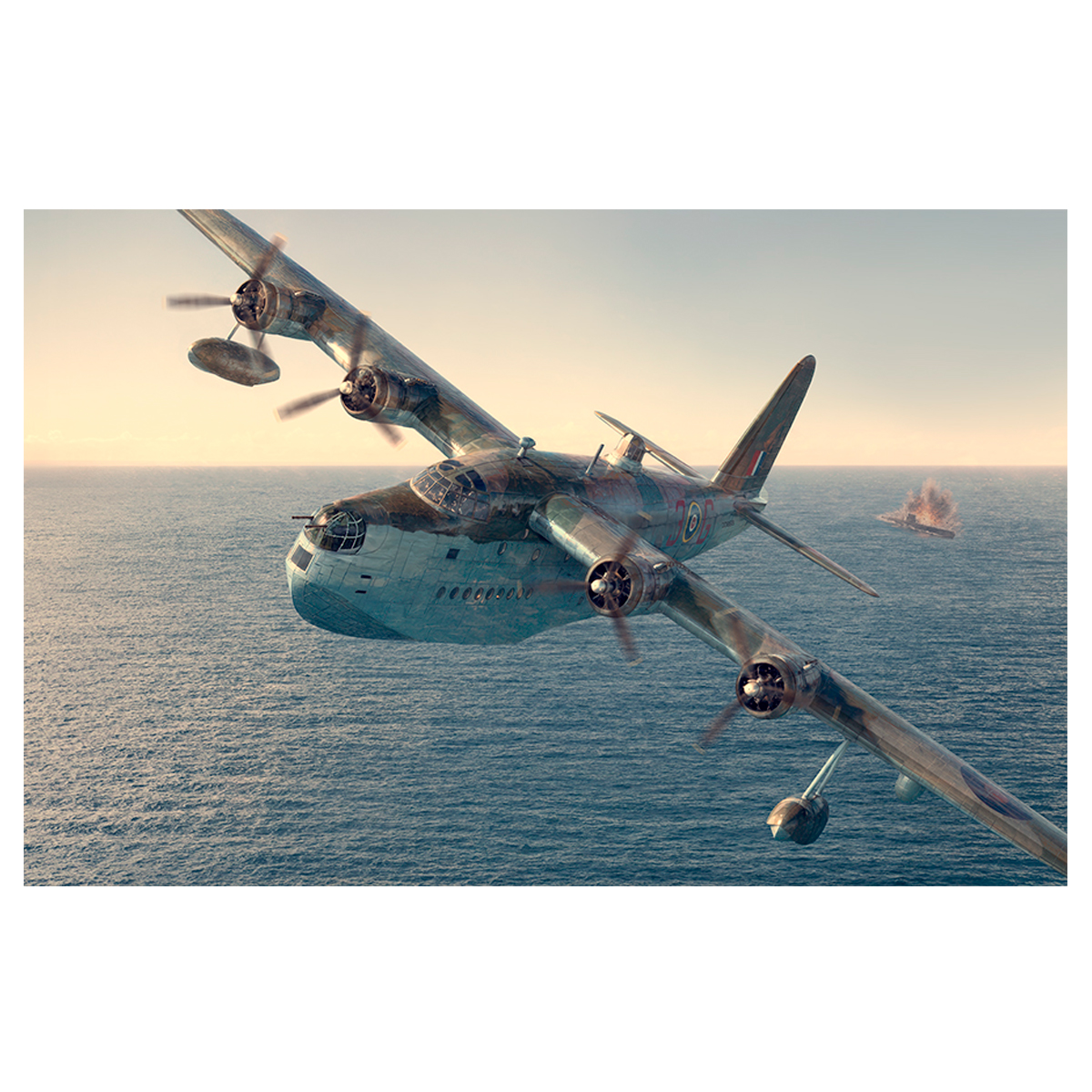
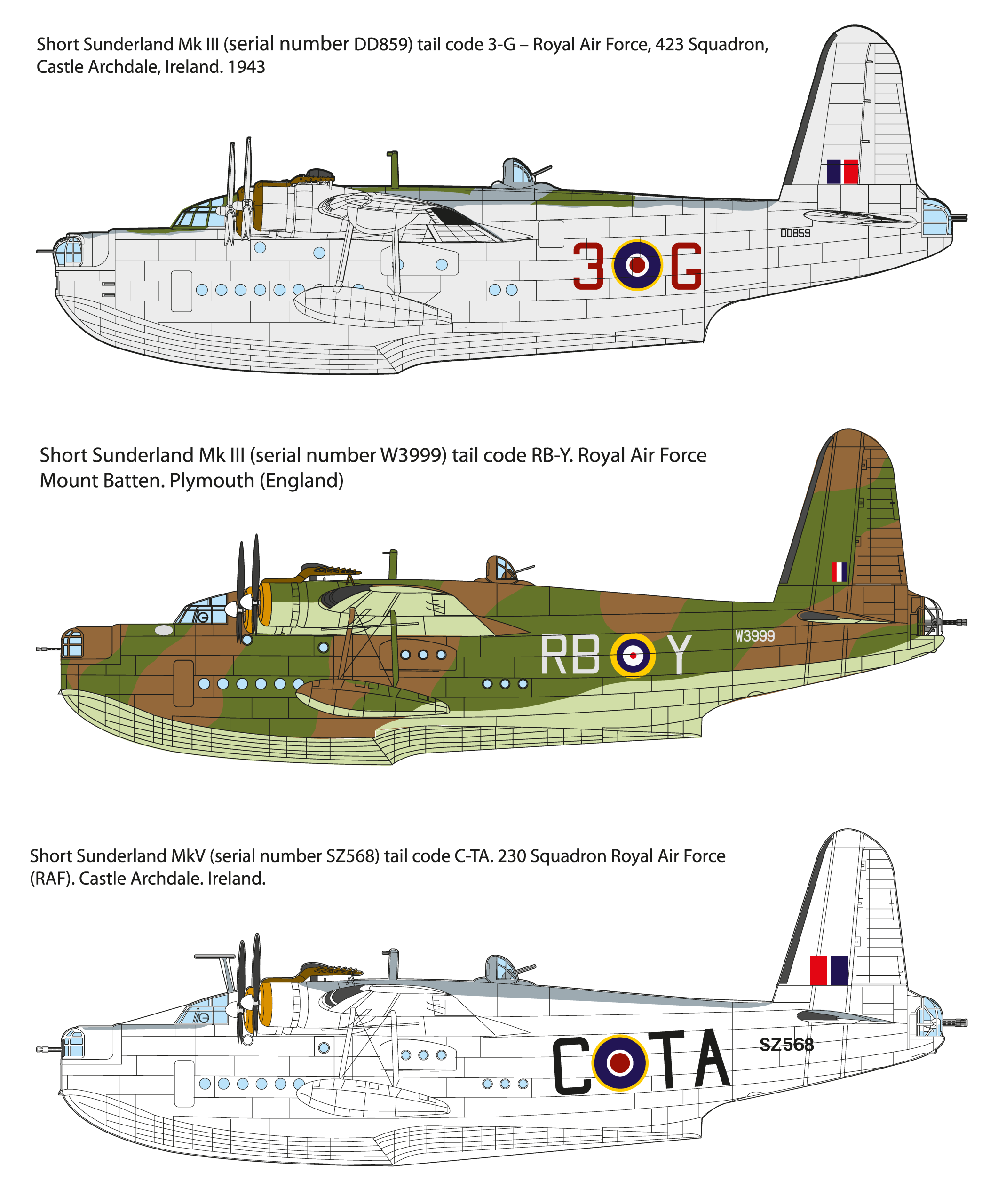
The Sunderland played a critical role in the Battle of the Atlantic, destroying around 28 German submarines and helping to sink seven more, earning it the nickname of «U-Boat Killer». A Short Sunderland Mk.III (code 3G) with the tail number DD859, under the command of Flying Officer Albert Bishop, sank the German Type XIV supply submarine U-489, known as a «Milchkuh» (Milk Cow), on 4 August 1943.
After World War II, the Short Sunderland played a unique and critical role in the Berlin Airlift, transporting vital materials to the city.
The Sunderland also saw combat during the Korean War and in operations in Malaysia. The last of the Royal New Zealand Air Force’s aircraft were not decommissioned until 1967.
The Sunderland was also used in civil aviation. In late 1942, the British Overseas Airways Corporation (BOAC) purchased six Sunderland Mark IIIs and adapted them for mail transport with primitive facilities for seven passengers to Nigeria and India. BOAC received more Mark IIIs and gradually developed better facilities for 24 passengers, including sleeping accommodation for 16. This conversion was called the Hythe; by the end of the war, BOAC had 29 Hythes. Another civil conversion of the Sunderland was the post-war Sandringham. Civilian versions of the aircraft were used for passenger transport until 1974.
Roden 1/144 Short S.25 Sunderland Mark III/V
Short Brothers fue uno de los mayores diseñadores y fabricantes de hidroaviones multimotor. En la década de 1930, cuando los monoplanos totalmente metálicos comenzaron a sustituir a los biplanos, Short Brothers diseñó una serie de hidroaviones civiles de cuatro motores: los modelos S.23, S.30 y S.33, conocidos como «Clase C» o «Clase Empire». Algunos de ellos se equiparon con material militar y se utilizaron en combate.
La experiencia adquirida durante la producción y el funcionamiento de estos hidroaviones sirvió de base para el desarrollo de un hidroavión de largo alcance destinado a misiones de patrulla marítima y antisubmarinas. El prototipo realizó su primer vuelo el 16 de octubre de 1937 con la denominación de Sunderland Mk.I. Durante su servicio, la aeronave fue objeto de mejoras. La siguiente versión, el Sunderland Mk.II, incorporó una torreta superior y motores Pegasus Mk.XVIII más potentes. Algunos de ellos se equiparon de forma experimental con radares ASV Mk.II.
El Sunderland Mk.III/IIIA recibió un fuselaje modernizado (con un escalón del casco rediseñado) y un radar ASV Mk.III en carenados en forma de lágrima situados bajo las alas. Las versiones posteriores contaban con cuatro ametralladoras fijas en el morro para combatir a las tripulaciones de los cañones antiaéreos de los submarinos. Se fabricaron un total de 456 aviones.
La versión final del Sunderland, el Mk.V, estaba propulsada por motores estadounidenses P&W R-1830-90B. El armamento era similar al del Mark III, pero el Mark V estaba equipado con un nuevo radar centimétrico ASV Mark VIC, que también se instaló en algunos de los últimos Mark III de producción. La producción continuó hasta junio de 1946 (155 unidades). Los nuevos motores ofrecían un mejor rendimiento sin una pérdida real de autonomía: el Sunderland podía mantenerse en el aire aunque fallaran dos motores de un ala, mientras que el Mark III estándar perdía altitud constantemente.
El Sunderland entró en servicio en 1938. Durante la guerra, estos aviones operaron sobre los océanos Atlántico, Índico y Pacífico, desde el Ártico hasta los trópicos. Los pilotos alemanes lo apodaron el «puercoespín volador» por su potente armamento defensivo.
El Sunderland desempeñó un papel fundamental en la Batalla del Atlántico, destruyendo alrededor de 28 submarinos alemanes y contribuyendo al hundimiento de otros siete, lo que le valió el apodo de «asesino de submarinos». Un Short Sunderland Mk.III (código 3G) con el número de cola DD859, bajo el mando del oficial de vuelo Albert Bishop, hundió el submarino de abastecimiento alemán Tipo XIV U-489, conocido como «Milchkuh» (vaca lechera), el 4 de agosto de 1943.
Tras la Segunda Guerra Mundial, el Short Sunderland desempeñó un papel único y crucial en el puente aéreo de Berlín, transportando materiales vitales a la ciudad.
El Sunderland también entró en combate durante la Guerra de Corea y en operaciones en Malasia. Los últimos aviones de la Real Fuerza Aérea de Nueva Zelanda no fueron retirados del servicio hasta 1967.
El Sunderland también se utilizó en la aviación civil. A finales de 1942, la British Overseas Airways Corporation (BOAC) adquirió seis Sunderland Mark III y los adaptó para el transporte de correo, con instalaciones rudimentarias para siete pasajeros, con destino a Nigeria y la India. La BOAC recibió más Mark III y desarrolló gradualmente mejores instalaciones para 24 pasajeros, incluyendo literas para 16. Esta conversión se denominó «Hythe»; al final de la guerra, la BOAC contaba con 29 «Hythe». Otra conversión civil del Sunderland fue el «Sandringham» de la posguerra. Las versiones civiles del avión se utilizaron para el transporte de pasajeros hasta 1974.

 Request of SDS product data file / Product security