


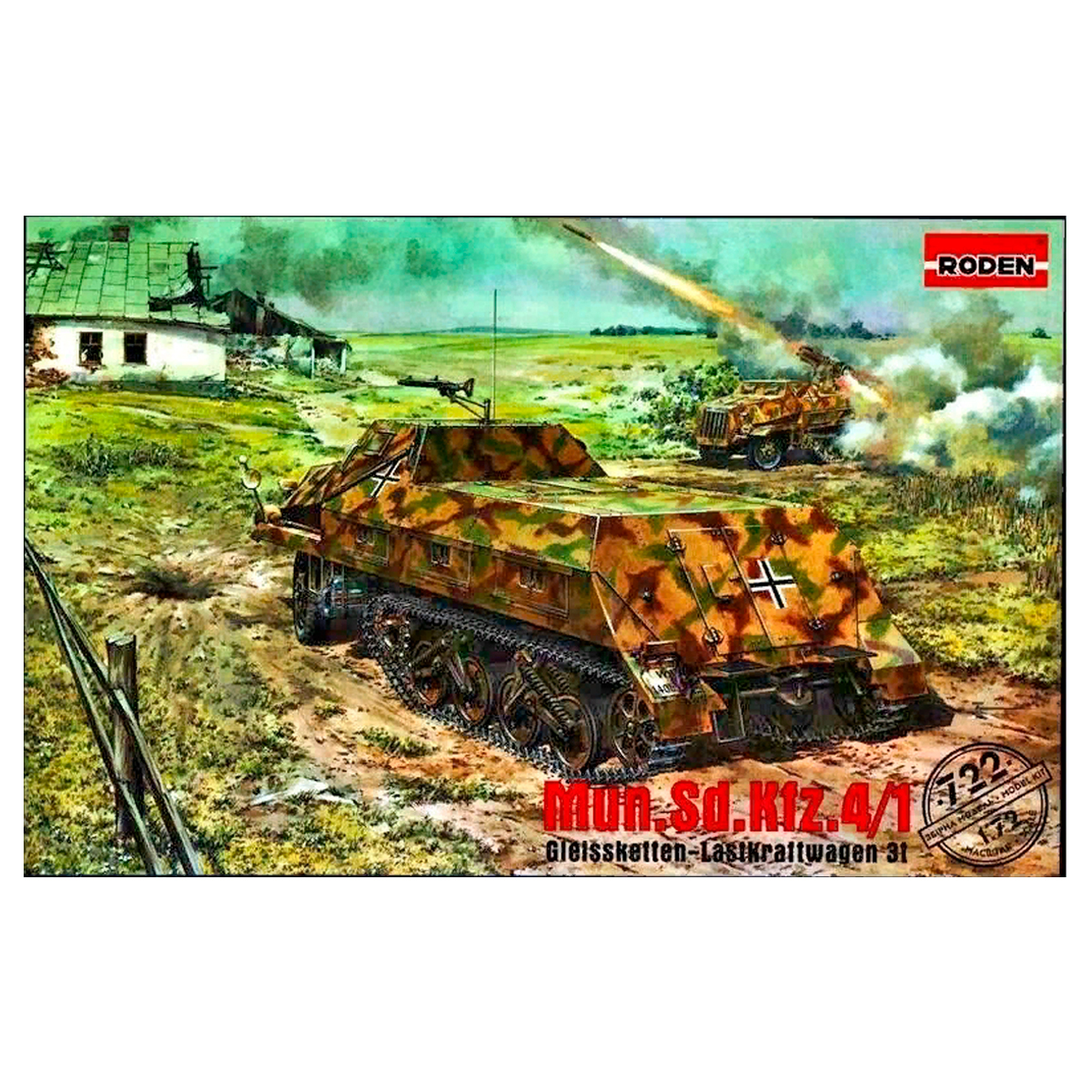


1/72 Munitionskraftwagen für Nebelwerfer, Sd.Kfz.4, Gleissketten-Lastkraftwagen 3t
13,49€
Solo quedan 1 disponibles

*Please check our Privacy Policies to see how to we use your personal data.
*Por favor revisa nuestra Política de Privacidad para ver como tratamos tus datos personales
Roden 1/72 Munitionskraftwagen für Nebelwerfer, Sd.Kfz.4, Gleissketten-Lastkraftwagen 3t
3-ton tracked truck (ammunition truck for smoke launchers, Sd.Kfz.4)
In early 1943 a ten-tube multiple rocket firing system, the Nebelwerfer 41, designed by Rudolf Nebel, was mounted on the chassis of the well-known Opel Blitz Maultier half-track.
The vehicle, later named the Sd.Kfz.4/1 Panzerwerfer 42, was completely covered with armor of varying thickness, and it offered its crews the potential of a responsive self-propelled artillery piece with significant advantages in case of firing, being able to quickly move away from the very visible smoke trails. The 158-mm rocket system designed by Nebel was a near-perfect development and quite different from its Soviet counterpart (the famous BM-13 Katyusha), with greater accuracy of shooting.
By 1943 the first production Panzerwerfers were sent to fighting units on the Eastern Front. Production of the self-propelled artillery was very slow, and so the use of these vehicles was quite limited.
The main drawback of the machine was the relatively small amount of ammunition available per vehicle – each Panzerwerfer 42 could transport only ten 34-kilogram rounds during combat operations in the launcher installation itself, above the armored body, and another ten within the hull. First, there was a plan to introduce the Sd.Kfz.250 half track for the transportation of additional ammunition into the organisation of combat units; however, the idea was later abandoned because of its ineffectiveness. It was decided to create an ammunition transporter on the exact same chassis and with the same design as the Panzerwerfer 42. The mobile launcher installation was removed for this purpose, and additional compartments for 10 rockets were installed inside the truck and a further container on the upper armor plate for another 10 rounds, so the transporter could carry thirty rockets.
The truck was designated the Munitionskraftwagen für Nebelwerfer (Sd.Kfz.4) and was incorporated into the combat units of tracked artillery.
During 1944-45, in addition to 300 Panzerwerfer 42 rocket firing systems, they managed to build at least 287 Munitionskraftwagen ammunition transporters, which were in use until the last days of the war on both the Eastern and Western Fronts.
Roden 1/72 Munitionskraftwagen für Nebelwerfer, Sd.Kfz.4, Gleissketten-Lastkraftwagen 3t
Camión de orugas de 3 t (camión de municiones para lanzadores de humo, Sd.Kfz.4)
A principios de 1943, se montó un sistema de lanzamiento múltiple de cohetes de diez tubos, el Nebelwerfer 41, diseñado por Rudolf Nebel, sobre el chasis del conocido semioruga Opel Blitz Maultier.
El vehículo, posteriormente denominado Sd.Kfz.4/1 Panzerwerfer 42, estaba completamente recubierto de blindaje de distintos grosores y ofrecía a sus tripulaciones el potencial de una pieza de artillería autopropulsada ágil, con ventajas significativas a la hora de disparar, ya que podía alejarse rápidamente de las estelas de humo, muy visibles. El sistema de cohetes de 158 mm diseñado por Nebel era un desarrollo casi perfecto y bastante diferente de su homólogo soviético (el famoso BM-13 Katyusha), con mayor precisión de tiro.
En 1943, los primeros Panzerwerfer de producción fueron enviados a las unidades de combate del Frente Oriental. La producción de la artillería autopropulsada fue muy lenta, por lo que el uso de estos vehículos fue bastante limitado.
El principal inconveniente del vehículo era la cantidad relativamente escasa de munición disponible por unidad: cada Panzerwerfer 42 solo podía transportar diez proyectiles de 34 kilogramos durante las operaciones de combate en la propia instalación del lanzador, situada sobre la carrocería blindada, y otros diez dentro del casco. En un principio, se planeó introducir el semioruga Sd.Kfz.250 para el transporte de munición adicional en la organización de las unidades de combate; sin embargo, la idea se abandonó posteriormente debido a su ineficacia. Se decidió crear un transportador de munición sobre el mismo chasis y con el mismo diseño que el Panzerwerfer 42. Para ello, se retiró la instalación de lanzamiento móvil y se instalaron compartimentos adicionales para 10 cohetes en el interior del camión, así como un contenedor más en la placa de blindaje superior para otros 10 proyectiles, de modo que el transportador pudiera llevar treinta cohetes.
El camión recibió la denominación de Munitionskraftwagen für Nebelwerfer (Sd.Kfz.4) y se incorporó a las unidades de combate de artillería sobre orugas.
Durante 1944-45, además de 300 sistemas de lanzamiento de cohetes Panzerwerfer 42, se fabricaron al menos 287 transportadores de municiones Munitionskraftwagen, que estuvieron en servicio hasta los últimos días de la guerra tanto en el frente oriental como en el occidental.

 Solicitud de ficha producto tipo SDS / Seguridad de producto