




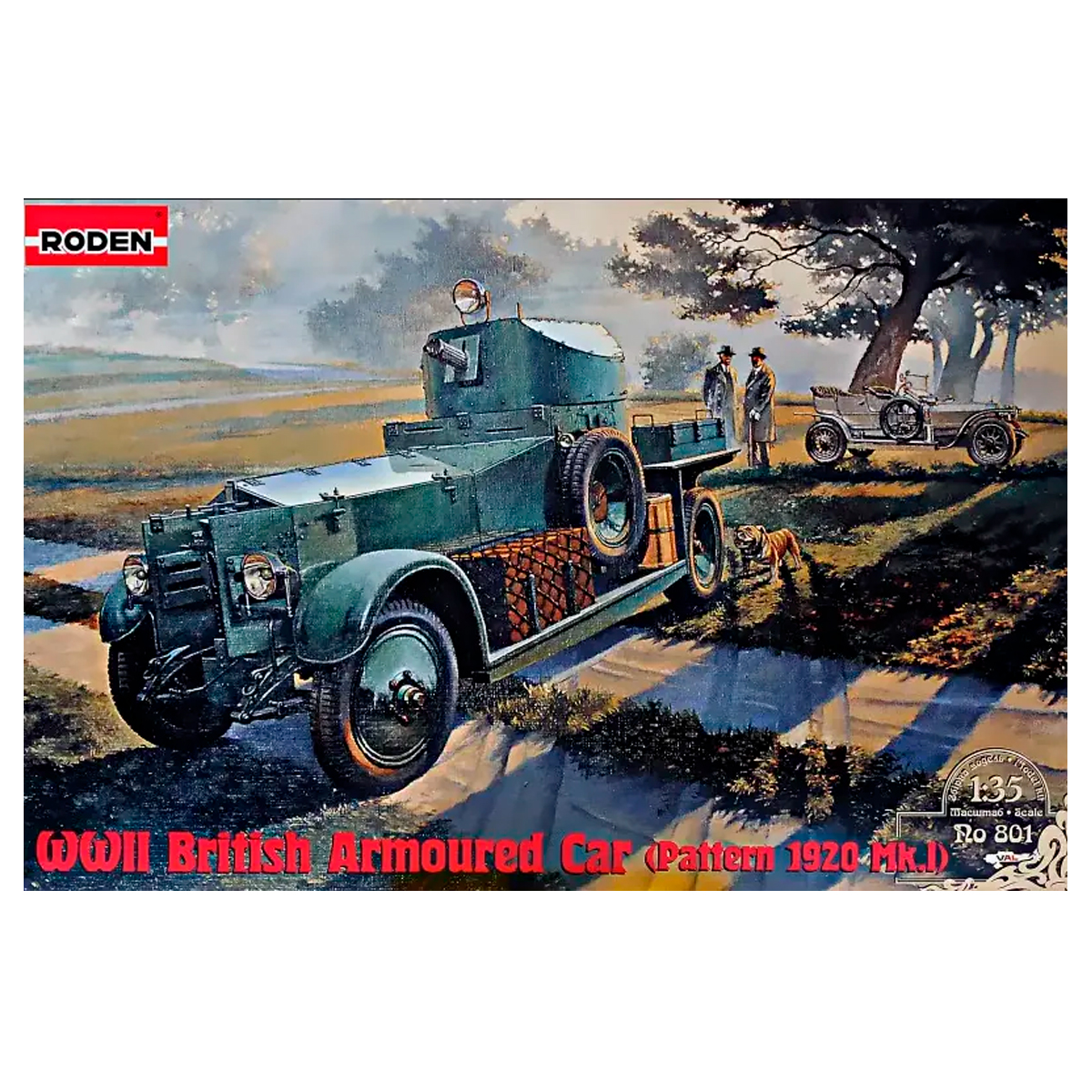
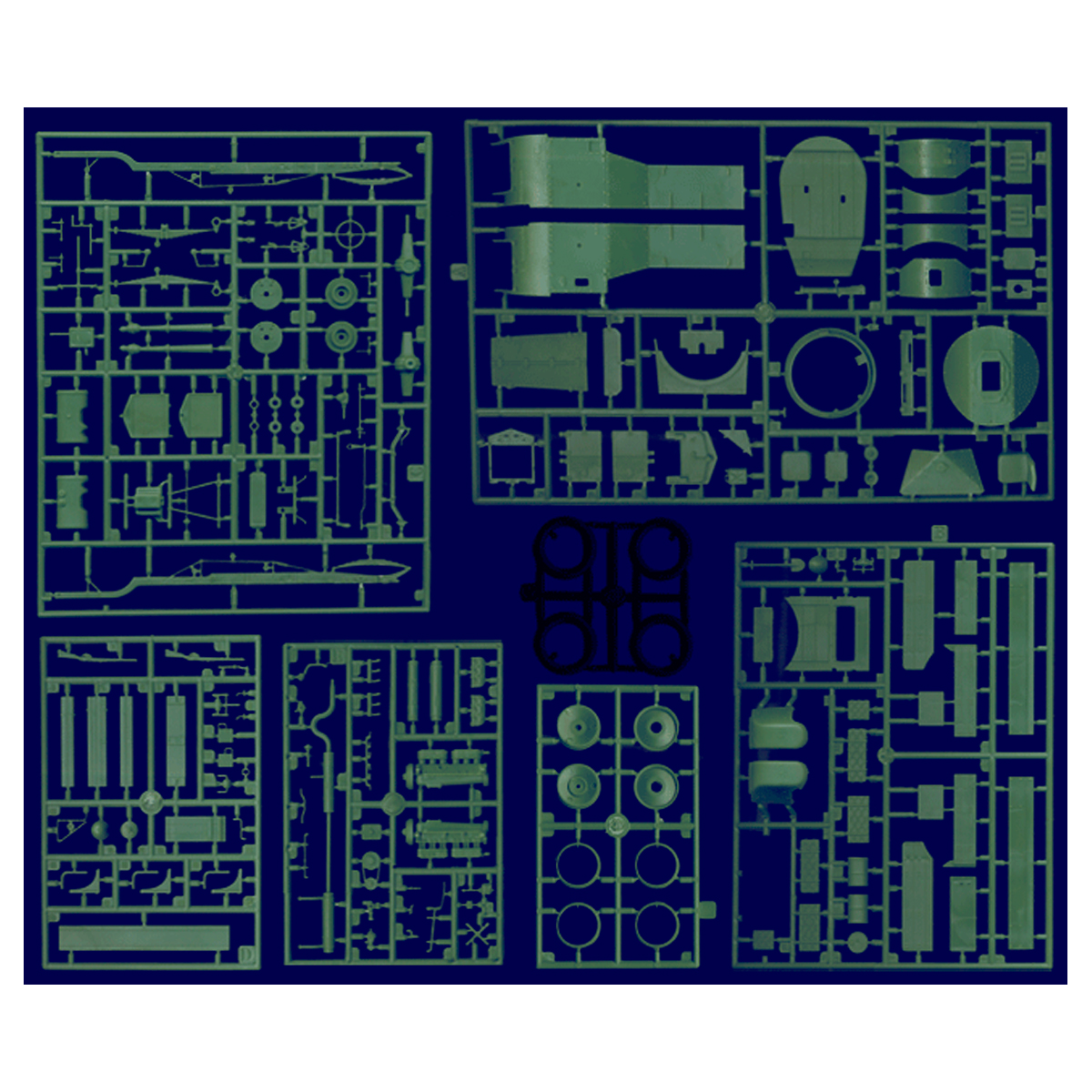



1/72 WWII British Armoured Car Pattern 1920 Mk.I
44,99€
Solo quedan 1 disponibles

*Please check our Privacy Policies to see how to we use your personal data.
*Por favor revisa nuestra Política de Privacidad para ver como tratamos tus datos personales
Roden 1/72 WWII British Armoured Car Pattern 1920 Mk.I
A history of this armored car would require a great many pages, devoted to its lengthy and varied service in the British armed services; and it is connected, oddly enough, with aviation. At the beginning of WWI the British military directed their thoughts to the need to protect newly built airfields against their being suddenly overwhelmed by enemy troops. The Royal Naval Air Service (RNAS) suggested to the Admiralty that a special armored car be developed, which could not only execute defensive functions but also as necessary support army units in combat, and fulfill communication and transport duties. Soon, the Air Department of the Admiralty made overtures to a firm in the motor industry, Rolls-Royce, which had been producing cars for about ten years.
In 1906 this firm introduced the highly successful Silver Ghost, which continued to be built by the factory while the War was already under way. Admiralty engineers developed an original simple armored superstructure for the Silver Ghost chassis, which appeared to be successful in all respects. In December 1914 the first three cars were issued to the army. A rotating turret fitted with a Vickers machine gun was installed on top of the armored body. On the whole the design appeared to be just what was wanted, and soon the motor company received a new order for additional cars.
With the onset of physical fighting at the Western Front soldiers became interested in the armored car. However, the idea of sending the car into the battle area, which featured impassable mud for kilometer after kilometer, was intimidating from the very beginning. The fragile suspension of this passenger car with an armored shell would never be able to survive in these conditions. The active military service of this car in the trench war was over before it had even begun. However the War quickly spread from Europe to other regions of the world. The Middle East, and Africa, where the war also began for the possession of the German colonies, were the most promising for the application of the fast and reasonably well protected armored car.
Instead of guarding airfields in the territory of Misty Albion, six newly formed squadrons of the Royal Naval Air Service were sent to the hot and dusty deserts of North Africa and to the Turkish province of Gallipoli, where the fighting had already been going on for some time. These cars were found to be highly useful weapons, and even the end of the Great War did not put a full stop to their career. In 1920 they underwent their first modernization. And four years later, another one. Elegant on a passenger car, but worse than useless for a military armored car, the spoke wheels were exchanged for ones with full metal disks. The form of the turret was changed for an open topped one, and instead of a Vickers gun, a Boys anti-tank rifle and a Bren light machine gun were fitted. It was also equipped with a smoke grenade launcher.
In the 1920s these cars continued to take part in armed service: in the colonies of Great Britain they co-operated with aviation, repressing local revolts by unarmed colonial tribes; and even in Europe employment was found for them, during the period of civil war in Ireland, when the British government delivered several armored cars to the Irish government to counter the attacks of the Irish Republican Army. These vehicles conducted their active service until 1944 and were retired only due to the complete wearing out of their working parts.
One of the cars passed into the hands of one of the best-known eccentric historical figures of the 20th Century, Lawrence of Arabia: his armored car was used by him during his guerrilla actions and other adventures in the Middle East. In due course the Thirties came to their end and there was again a smell of war in the air. There was extensive modernization in Europe, and also in the armor of the British Army. At the time about one hundred Armoured Cars remained in service in the colonies. The majority (about 70) of them were in North Africa, where they soon faced Italian troops. Some more were in India, carrying out raids in the territory of neighboring Burma.
Today, some original armored cars of this type have been preserved in different countries of the world. They have been quite valuable private property for a long time now, and remind us of those distant times, when the first blundering motorized constructions, weakly protected against an opponent’s firearms, enabled rapid development of a military technical idea and led to the appearance of more modern mobile weapons in the future.
Roden 1/72 WWII British Armoured Car Pattern 1920 Mk.I
La historia de este vehículo blindado requeriría muchas páginas, dedicadas a su largo y variado servicio en las Fuerzas Armadas británicas; y, por extraño que parezca, está relacionada con la aviación. Al comienzo de la Primera Guerra Mundial, el ejército británico se planteó la necesidad de proteger los aeródromos de reciente construcción para evitar que fueran invadidos repentinamente por las tropas enemigas. El Servicio Aéreo Naval Real (RNAS) sugirió al Almirantazgo que se desarrollara un vehículo blindado especial, que no solo pudiera desempeñar funciones defensivas, sino también, en caso necesario, apoyar a las unidades del ejército en combate y cumplir tareas de comunicación y transporte. Pronto, el Departamento Aéreo del Almirantazgo se puso en contacto con una empresa del sector del motor, Rolls-Royce, que llevaba unos diez años fabricando automóviles.
En 1906, esta empresa presentó el exitoso Silver Ghost, que la fábrica siguió fabricando mientras la guerra ya estaba en marcha. Los ingenieros del Almirantazgo desarrollaron una superestructura blindada sencilla y original para el chasis del Silver Ghost, que parecía ser un éxito en todos los aspectos. En diciembre de 1914 se entregaron los tres primeros vehículos al ejército. Se instaló una torreta giratoria equipada con una ametralladora Vickers en la parte superior de la carrocería blindada. En general, el diseño parecía ser justo lo que se buscaba, y pronto la empresa automovilística recibió un nuevo pedido de vehículos adicionales.
Con el inicio de los combates en el frente occidental, los soldados comenzaron a interesarse por el vehículo blindado. Sin embargo, la idea de enviar el vehículo a la zona de combate, caracterizada por un barro intransitable que se extendía kilómetro tras kilómetro, resultaba intimidante desde el primer momento. La frágil suspensión de este turismo con carrocería blindada nunca habría podido sobrevivir en esas condiciones. El servicio militar activo de este vehículo en la guerra de trincheras había terminado antes incluso de haber comenzado. Sin embargo, la guerra se extendió rápidamente desde Europa a otras regiones del mundo. Oriente Medio y África, donde la guerra también comenzó por la posesión de las colonias alemanas, eran los escenarios más prometedores para el uso del vehículo blindado, rápido y razonablemente bien protegido.
En lugar de proteger los aeródromos del territorio de la Brumosa Albión, seis escuadrones recién formados del Servicio Aéreo Naval Real fueron enviados a los desiertos calurosos y polvorientos del norte de África y a la provincia turca de Galípoli, donde los combates ya llevaban tiempo en curso. Estos vehículos resultaron ser armas de gran utilidad, y ni siquiera el fin de la Gran Guerra puso punto y final a su carrera. Se cambió la forma de la torreta por una de techo abierto y, en lugar de una ametralladora Vickers, se instalaron un rifle antitanque Boys y una ametralladora ligera Bren. También se equipó con un lanzagranadas de humo.
En la década de 1920, estos vehículos continuaron participando en el servicio armado: en las colonias de Gran Bretaña cooperaron con la aviación, reprimiendo revueltas locales de tribus coloniales desarmadas; e incluso en Europa se les encontró un uso, durante el periodo de la guerra civil en Irlanda, cuando el gobierno británico entregó varios vehículos blindados al gobierno irlandés para contrarrestar los ataques del Ejército Republicano Irlandés. Estos vehículos permanecieron en servicio activo hasta 1944 y solo fueron retirados debido al desgaste total de sus piezas funcionales.
Uno de los vehículos pasó a manos de una de las figuras históricas excéntricas más conocidas del siglo XX, Lawrence de Arabia: utilizó su vehículo blindado durante sus acciones de guerrilla y otras aventuras en Oriente Medio. Con el tiempo, los años treinta llegaron a su fin y volvió a haber un aire de guerra en el ambiente. Se produjo una amplia modernización en Europa, y también en el armamento del ejército británico. En aquel momento, alrededor de cien vehículos blindados seguían en servicio en las colonias. La mayoría (unos 70) se encontraban en el norte de África, donde pronto se enfrentaron a las tropas italianas. Otros cuantos estaban en la India, llevando a cabo incursiones en el territorio de la vecina Birmania.
Hoy en día, se conservan algunos vehículos blindados originales de este tipo en diferentes países del mundo. Desde hace mucho tiempo son una valiosa propiedad privada y nos recuerdan aquellos tiempos lejanos, cuando las primeras y torpes construcciones motorizadas, débilmente protegidas contra las armas de fuego del enemigo, permitieron el rápido desarrollo de una idea técnico-militar y condujeron a la aparición de armas móviles más modernas en el futuro.

 Solicitud de ficha producto tipo SDS / Seguridad de producto